
Install MongoDB on Debian 12 VPS: Complete Guide to Self-Hosting for Cost Savings
Step-by-step guide to install MongoDB 7.0 on Debian 12 VPS with low memory configuration, remote access setup, authentication, and cost-saving tips.
Published on: Friday, Jan 9, 2026


Looking to reduce your cloud database costs or gain more control over your data? Self-hosting MongoDB on a VPS is a compelling option. This guide walks you through installing MongoDB 7.0 on Debian 12, configuring it for low-memory environments, enabling remote access, and setting up authentication—complete with solutions to common issues you might encounter.
Why Self-Host MongoDB?
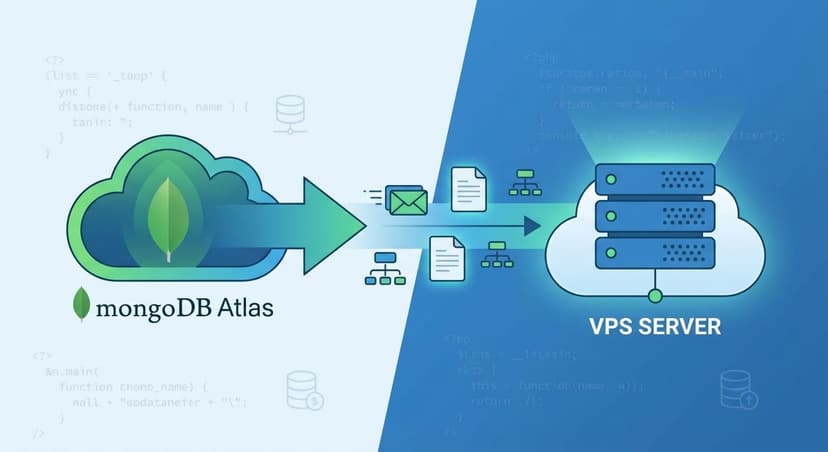
Managed database services like MongoDB Atlas are convenient for getting started, but self-hosting gives you full control and can significantly reduce costs—especially for development, testing, or smaller production workloads. A budget VPS can handle MongoDB surprisingly well with the right configuration.
Prerequisites
- A Debian 12 (Bookworm) VPS with SSH access
- Root or sudo privileges
- At least 512MB RAM (we'll configure for low memory)
- Basic terminal knowledge
Step 1: Install MongoDB 7.0 on Debian 12
First, let's add the official MongoDB repository and install the database server. SSH into your VPS and run:
Step 2: Configure MongoDB for Low Memory (Critical!)
This is a common roadblock. By default, MongoDB's WiredTiger engine uses 50% of available RAM for cache. On a low-memory VPS, that's problematic. Edit the configuration file:
Add or modify the storage section. Important: The minimum cacheSizeGB is 0.25 (256MB). I initially tried 0.1 and MongoDB refused to start!
Step 3: Create Log Directory (Easy to Miss!)
Another issue I encountered: MongoDB wouldn't start because the log directory didn't exist. Fix it:
Step 4: Start MongoDB
You should see "active (running)" in green. If not, check the logs:
Step 5: Enable Remote Access (The bindIp Trap)
By default, MongoDB only listens on localhost (127.0.0.1). When I tried connecting from my development machine, I got:
The fix: Update bindIp in /etc/mongod.conf:
Then restart MongoDB and open the firewall:
Step 6: Set Up Authentication (Don't Skip This!)
With the port open to the internet, you MUST enable authentication. First, create an admin user:
Now enable authentication in mongod.conf:
Step 7: Your Connection String
You can now connect from anywhere using this connection string format:
Replace YOUR_VPS_IP with your server's public IP address. Test with mongosh:
Memory Usage Results
Here's typical resource usage on a 512MB RAM VPS after setup:
| Resource | Usage |
|---|---|
| MongoDB Memory | ~71MB |
| Available RAM | ~279MB |
| Swap Used | ~74MB |
| Total Documents | 2729 |
| Database Size | 15MB |
The VPS handles development workloads without any issues. For production with larger datasets, you'll want at least 2-4GB RAM.
Production Notes for Larger VPS
When moving to production with a beefier VPS, consider these additional hardening steps:
- Enable TLS/SSL - Encrypt all connections with certificates
- IP Whitelisting - Restrict bindIp to known application servers only
- Automated Backups - Set up daily mongodump with cron jobs
- Increase Cache Size - Set cacheSizeGB to 50% of available RAM
- Disable Transparent Huge Pages - MongoDB recommends this for performance
- Role-Based Users - Create separate users for app, backup, and admin tasks
FAQs - Issues I Encountered
Q: MongoDB won't start with "cacheSizeGB must be >= 0.25" error
A: The WiredTiger storage engine requires a minimum cache of 256MB (0.25GB). You cannot set cacheSizeGB lower than this value, even on low-memory systems. If your VPS has less than 512MB RAM, MongoDB will still work but may use swap.
Q: Getting "No such file or directory" for /var/log/mongodb/mongod.log
A: The log directory doesn't exist by default. Create it with: sudo mkdir -p /var/log/mongodb && sudo chown mongodb:mongodb /var/log/mongodb
Q: Connection refused when connecting remotely
A: Check two things: 1) Is bindIp set to 0.0.0.0 in mongod.conf? The default 127.0.0.1 only allows local connections. 2) Is your firewall allowing port 27017? Use: sudo ufw allow 27017/tcp
Q: SSH tunnel vs direct connection - which is better?
A: SSH tunnels are more secure (MongoDB port stays closed) but require maintaining the tunnel. Direct connection with authentication + TLS is simpler for production. For development testing, direct connection with strong passwords is acceptable.
Q: How do I verify MongoDB is listening on the right IP?
A: Run: ss -tlnp | grep 27017. You should see 0.0.0.0:27017 for remote access, not 127.0.0.1:27017.
Q: What's the minimum VPS spec for MongoDB?
A: For testing/development: 512MB RAM works fine with small datasets (<50MB). For production: 2GB+ RAM minimum, 4GB+ recommended for datasets over 1GB.
Conclusion
Self-hosting MongoDB on a budget VPS is absolutely viable for development and testing workloads. The key learnings: always configure cacheSizeGB for low-memory systems, remember to change bindIp for remote access, and never skip authentication. For roughly $5-10/month, you get full control over your database—a fraction of managed service costs.
Stay Updated
Get the latest updates and insights directly to your inbox.